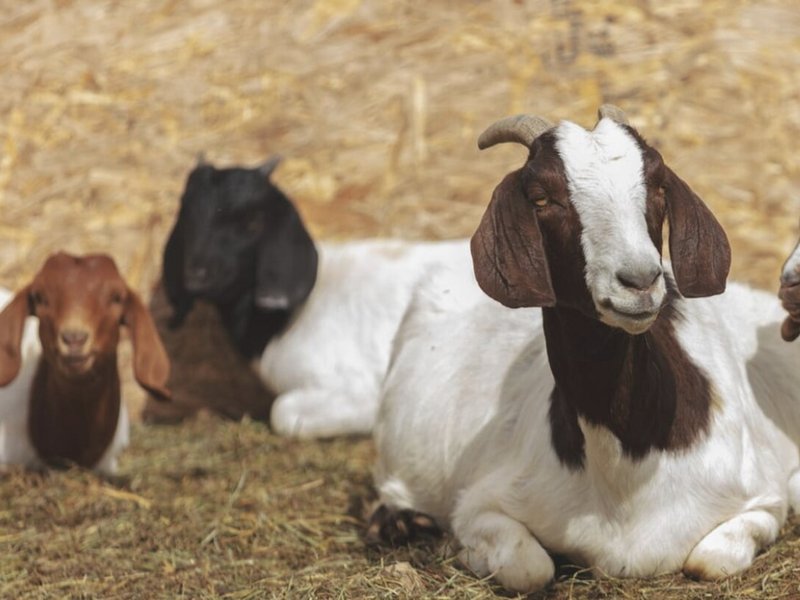
There is an important difference between roaming livestock animals and feral roaming animals, even though this may not be obvious at first. The main differences are explained below. In this article, goats are used as an example because this is especially relevant for Statia.
Goats on Statia are non-native animals that have become invasive. This means they were brought to the island by people and do not naturally belong here. When their numbers are not controlled, goats can damage the natural environment and cause problems for the economy, the environment and human health. This is what makes them an invasive species.
Not all non-native species are harmful. Some can be useful. For example, mango trees were also brought to the island from India. They provide food and other benefits and do not upset the natural balance. When invasive species such as goats are properly managed, their impact on nature can be limited and, in some cases, they can even be beneficial.
A roaming livestock goat is a domesticated animal that belongs to an owner but is allowed to move freely without proper fencing or supervision. These goats may return to their owners for food, but when left unsupervised they can damage crops, private property and natural areas.
A feral roaming goat is not domesticated and no longer has an owner. These goats live completely in the wild and do not depend on people for food, shelter, breeding or care. Their behaviour is driven by instinct, and they reproduce without control. They form groups that are increasingly difficult to manage. This makes them an unreliable source of food and places greater pressure on the island’s natural environment. On Statia, feral roaming goats are mainly found in Boven National Park.
Because roaming livestock animals can damage crops, gardens and natural areas, Statia has laws in place to manage livestock. For example, Article 3.3.3 of the APV prohibits livestock from roaming freely. These rules support safe and reliable local food production.
To deal with these challenges, the Nature and Environment Policy Plan (NEPP) includes a project to humanely remove feral roaming animals, starting in Boven National Park. This work will be carried out safely and carefully by local hunters and invasive species specialists.
In addition, the Strategic Action Plan for Sustainable Agriculture (SAPSA) has started work on live capture methods. This will help build a well-managed local herd and support a stable and responsibly maintained meat supply.
These actions are necessary to strengthen local food production, protect nature and support fair and sustainable livestock management for the benefit of the whole island.
For the SAPSA, click here: Openbaar Lichaam Sint Eustatius: SAPSA. For the NEPP, click here: Openbaar Lichaam Sint Eustatius: NEPP.
(1)What are Invasive Species? | National Invasive Species Information Center. (n.d.). https://www.invasivespeciesinfo.gov/what-are-invasive-species